The Bench
Gluten-Free Bread Equipment: Dutch Oven, Scale, Steel, and What You Can Skip
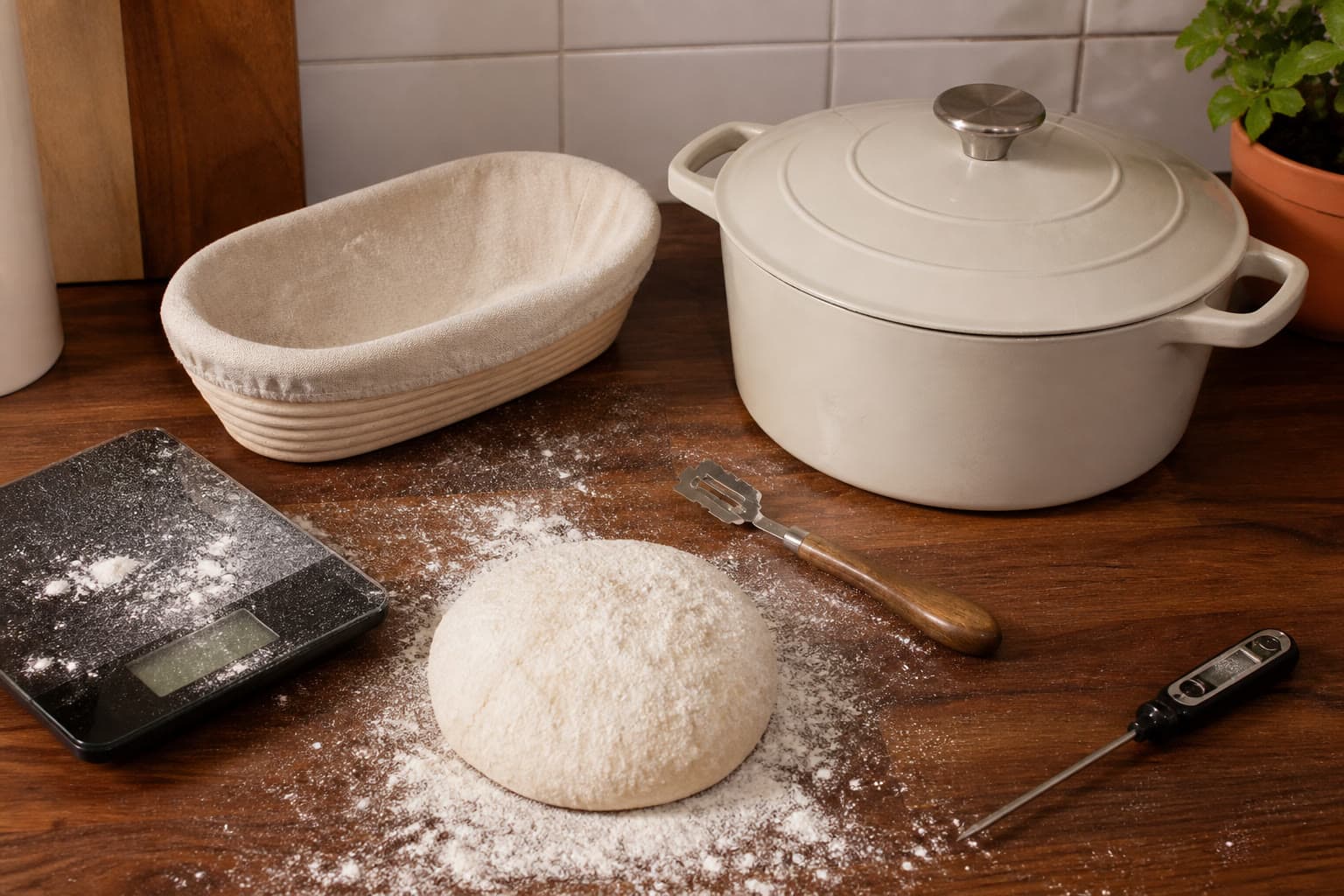
The essential gluten-free sourdough tools are a digital scale, a lidded pot or Dutch oven for steam, parchment, a cooling rack, and an instant-read thermometer. A steel helps pizza and bottoms. A lame is optional because gluten-free dough has little scoring spring. Pans support wet 90-110% hydration dough that would otherwise spread.
What this guide covers
What actually changes a gluten-free loaf: a scale, an instant-read thermometer, a Dutch oven or steel, pans that support wet dough, and why a lame is mostly for looks.
Key takeaways
- A digital scale is not optional once you care about 4-7% psyllium and 90-110% hydration.
- A preheated Dutch oven is the simplest path to steam and crust at home.
- A baking steel or stone helps bottoms crisp, especially for pizza and pan loaves.
- A lame has limited structural benefit on gluten-free dough; shallow scores are mostly decorative.
- A lined bowl substitutes for a banneton; the support matters more than the wicker.
- Sandwich bread, focaccia, bagels, and muffins succeed because pans and rings hold a wet gel.
- An instant-read thermometer aiming for about 205-210F inside prevents gummy centers.
- Dedicated gluten-free tools matter if you also bake wheat or serve celiac eaters.
- You can start with a scale, a pot with a lid, parchment, and a cooling rack.
- Fancy proofing boxes do not replace a peaked starter or a 2-hour cool.
The direct answer: buy the scale first
Gluten-free sourdough is a percentage craft. If you cannot weigh flour, water, and psyllium, you cannot stay in the 90-110% hydration and 4-7% husk windows except by luck. The second purchase is steam: a Dutch oven or any heavy pot with a lid that can take 500F. The third is an instant-read thermometer so you stop guessing at gumminess.
Everything else is a kindness. Steels, lames, rattan bannetons, proofing boxes, and extra mixing bowls make the work nicer. They do not replace peak starter, a rest after mixing, or a 2-hour cool.
If you bake for celiac eaters, also budget for dedicated versions of porous tools. A second wooden board is cheaper than a medical week.
The digital scale
Get a scale that reads in 1g increments and can tare. Place the bowl, tare, add sorghum, tare, add starch, tare. Weigh water. Weigh husk. Weigh salt. Weigh starter. This is faster than cups once your hands learn it, and it is the only way powder-versus-husk conversions make sense.
A scale that maxes out at 5kg is plenty. Battery-powered is fine. We wipe ours because psyllium gel is glue. We do not use it as a shelf for keys.
If two people bake, agree on grams. Claire will not convert Andrew's 'heaping cup of tapioca' into a formula. That cup is how loaves go gummy.
Bowls, spatulas, and mixers
A large mixing bowl and a strong spatula will mix 500-600g flour doughs. The dough is a thick batter; you are folding and smearing, not kneading. A stand mixer paddle on low-medium saves a wrist. A dough hook chases the gel around and does not develop gluten that is not there.
Glass lets you see whether flour is hiding at the bottom. Plastic is light. Stainless is durable. Pick one you can dedicate if you also make wheat pasta.
A second bowl is useful for blooming psyllium gel while the flours wait. That is the whole 'extra dish' argument against the gel method, and it is a small argument.
Dutch oven: the steam chamber
Preheat the pot and lid 30-45 minutes at 475-500F. Load the loaf on parchment, lid on 30-40 minutes, lid off 15-25 minutes. The enclosed steam gelatinizes the crust before it dries, then dry heat browns it. This is the home version of a deck oven's steam injection, and it is why our artisan loaf has a crust worth chewing.
Cast iron and enameled cast iron both work. Check that the knob can handle the heat or swap it for a metal one. A 5-7 quart pot fits a 500g flour boule. Tiny pots squash; giant pots waste steam.
No Dutch oven? A heavy stainless pot, a clay baker, or a loaf pan covered with foil for the first phase can work. You are improvising steam, not failing as a person.
Baking steel and stone
A steel stores heat and dumps it into pizza bottoms and the underside of pan loaves. Preheat longer than you think, especially a thick steel. Launch wet gluten-free pizza on parchment so you do not weld a disc to the steel. After a few minutes you can pull the paper if you want more direct contact.
A stone is cheaper and more fragile. An inverted sheet pan is cheaper still. For focaccia, the steel under the pan is a quiet upgrade.
Do not put a cold steel into a maxed-out broiler and then also expect your starter to be the problem when dinner is late. Preheat is part of the recipe.
The lame: limited scoring benefit
Wheat dough has a skin under tension. A lame cut directs expansion into an ear. Gluten-free gel does not have that skin in the same way. A deep score can deflate a fragile proof. A shallow score can look like a leaf and can keep a random split from wandering down the side.
We own a lame and use it when we want the loaf to photograph like a bakery. We skip it when we want dinner. A sharp knife, wet, can do the shallow cut. Scissors can snip a sandwich loaf.
If scoring is your favorite part of baking, keep doing it. Just do not troubleshoot a missing ear as a fermentation failure. The structure never promised you one.
Banneton versus bowl
A banneton (proofing basket) supports the sides of a wet dough so it proofs up instead of out. Line it. Rice flour on a cloth liner is our anti-stick. Naked rattan will glue itself to psyllium gel and tear the surface, which then spreads.
A medium mixing bowl plus a floured tea towel is the same tool in sweatpants. We used bowls for a year. The wicker is pretty. The geometry is the point.
Oval bannetons make batards that fit some pots better. Round bowls make boules. Sandwich dough skips both and goes in a pan, which is the most honest support of all.
Pans, rings, and the shapes that forgive
Sandwich bread wants a loaf pan, greased or parchment-slung. Focaccia wants a rectangular pan you can oil generously. Pizza wants a peel or parchment and a steel, or a well-heated sheet. Bagels want a boiled-water pot and a sheet; they also want enough psyllium to hold a hole. English muffins want rings so the batter does not become one large pancake.
Dark nonstick pans brown faster; glass lets you see the bottom but bakes slower. We like metal. We do not cool gluten-free loaves in the pan for an hour; they sweat. Ten minutes, then a rack, then the 2-hour wait.
Muffin tins make discard muffins. Cast-iron skillets make a handsome focaccia. Use what you have before you buy a specialty pan for a shape you will bake twice.
Instant-read thermometer
Insert into the center. About 205-210F is our done zone for loaves. Pizza will not get a meaningful center reading the same way; look for browned bottom and set crumb. Pancakes are not a thermometer project.
This tool ends arguments about gumminess after a proper cool. If you hit temperature and cooled 2 hours and the crumb is still wet, the formula is the suspect, not the clock.
Wipe the probe. Do not leave it in the loaf in the oven unless it is rated for that. Instant-read means in and out.
Steam and oven setup in a normal home oven
Home ovens lie about temperature. An inexpensive oven thermometer is a useful fourth purchase if your loaves brown oddly. Preheat longer than the beep. Hot spots are real; rotate uncovered loaves if one side paints faster.
If you skip the Dutch oven, you can add steam with a tray of water or wet towels on a pan for the first 15 minutes, then remove them. It is fiddly. The pot is easier. Do not swing a kettle of water into a 500F oven if you are not calm about steam burns.
Leave space for the rack. A loaf jammed against the roof browns on top and stays pale on the sides. We bake one boule at a time on weeknights. Two is a Saturday.
Nice-to-haves we actually use
Parchment sheets. A bench scraper for messy counters, not for 'cutting dough strength.' A shower cap to cover bowls. A spray bottle to wet hands. Silicone gloves to lift a 500F lid. A wire rack that is not coated in wheat crumbs. A notebook.
A mill is optional and wonderful if you like millet and buckwheat freshly ground; it is also a flour-dust machine, so read the celiac guide before you mill wheat in the same room.
Proofing mats, cloches, and extra bannetons are for when the hobby has already stuck. They are not the on-ramp.
Budget setup versus dedicated celiac setup
Budget: thrifted lidded pot, grocery-store scale, one bowl, parchment, the oven you have. You can bake the classic loaf on that list.
Dedicated celiac: the same list, but none of it has mixed wheat dough, plus a dedicated toaster and board. That is the expensive part psychologically, not financially.
We still bake in hoodies. The equipment is not a personality. It is how the gel meets heat.
FAQ
Do I need a Dutch oven for gluten-free sourdough?
You need trapped steam and high heat. A Dutch oven is the easiest way. A lidded roaster, a pot and a baking sheet lid, or a loaf pan with a foil tent can stand in.
Is a kitchen scale necessary for gluten-free bread?
Yes if you want repeatable 4-7% psyllium and 90-110% hydration. Cups of starch and sorghum do not agree. Grams do.
Should I score gluten-free sourdough with a lame?
You can, shallowly, for looks or to pick a split location. You will not get a wheat-style ear. Many of our loaves go unscored into a hot pot.
Banneton or bowl for gluten-free dough?
Either, if lined. The dough needs side support. A towel-lined mixing bowl works. Rice flour on the liner prevents sticking.
What internal temperature is gluten-free bread done?
We look for about 205-210F in the center. Color alone underbakes wet gels. Cool at least 2 hours after that reading.
Do I need a stand mixer?
No. A stiff spatula can mix these doughs. A paddle attachment is nice for sandwich batches. A dough hook is the wrong shape for a batter-like gel.
Baking steel or stone for gluten-free pizza?
A steel or stone preheated thoroughly makes a better bottom. A hot inverted sheet pan is the budget version. Launch on parchment if the dough is wet.
What size loaf pan for gluten-free sandwich bread?
An 8.5x4.5 inch pan gives height with a 500g flour dough; a 9x5 can look squat unless you scale up. Grease well or use a sling of parchment.
Can I use a bread machine?
You can mix in one if the paddle handles a thick batter, but bake in a Dutch oven or pan for crust. Machines designed for wheat cycles will not read gluten-free proofing well.
What is the cheapest setup that still works?
Scale, mixing bowl, spatula, parchment, any heavy lidded pot, oven, rack, and a thermometer. Add a steel when pizza night becomes a habit.
Bake from this
Related recipes
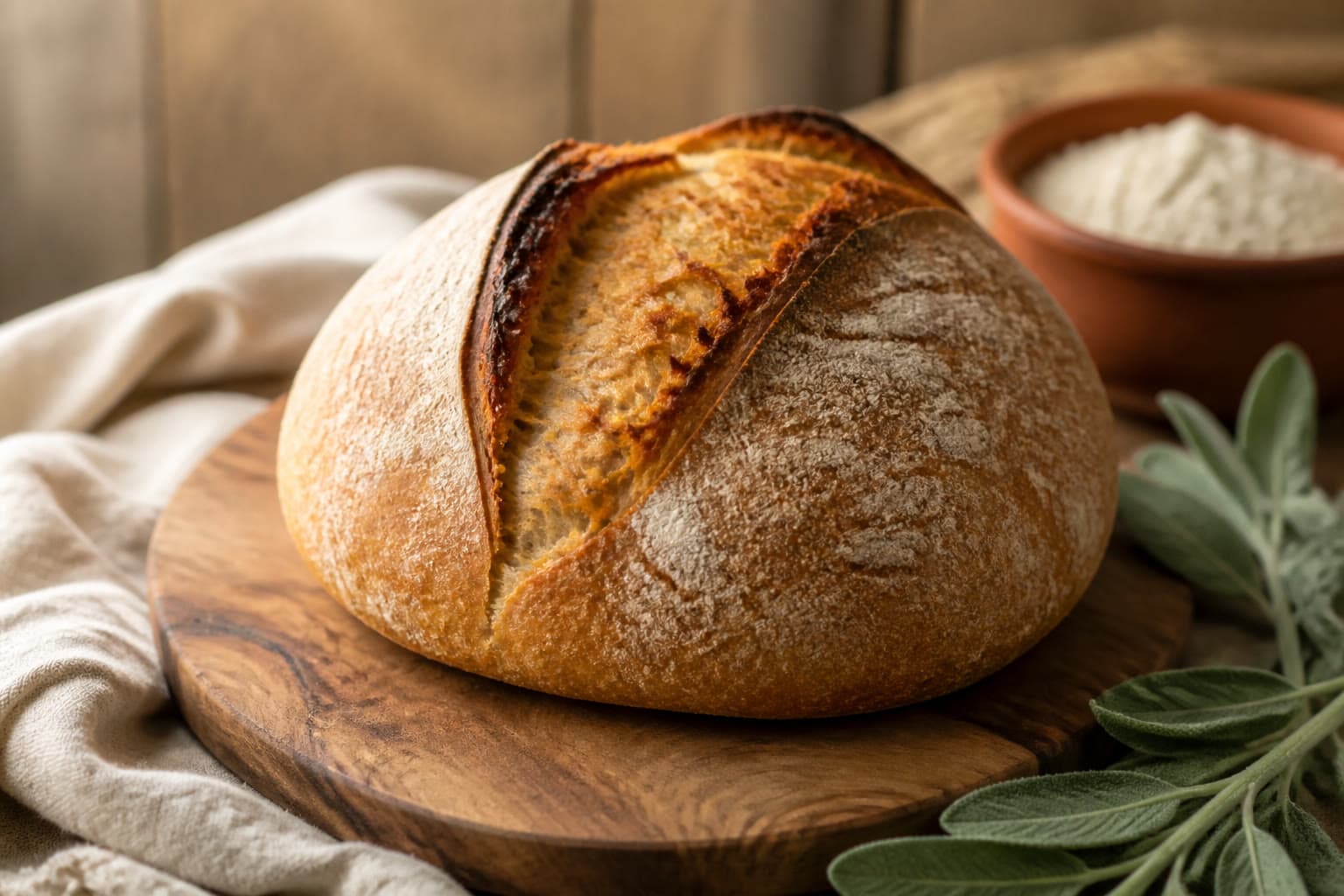
Artisan Loaves
INTERMEDIATE
GLUTEN FREE SOURDOUGH
NOV 7, 2025
Artisan Gluten-Free Sourdough Bread
Our upgraded house boule: King Arthur gluten-free bread flour, whole psyllium husk, and a 500F Dutch oven for a blistered crust.
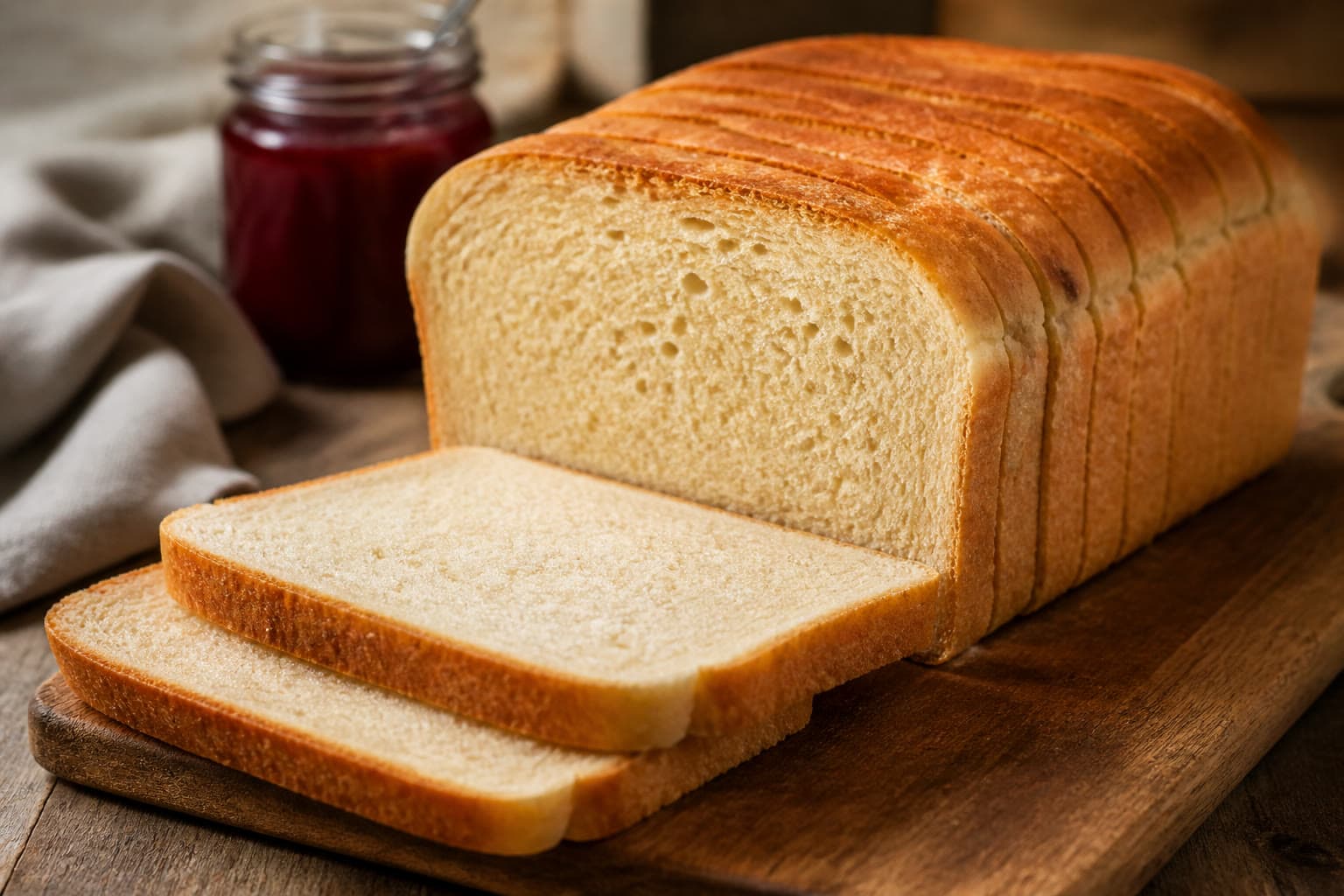
Sandwich Breads
BEGINNER
SANDWICH
MAR 1, 2026
Gluten-Free Sourdough Sandwich Bread
A Pullman-style pan loaf with extra starch, milk, and 4.5% psyllium for square, toastable slices.
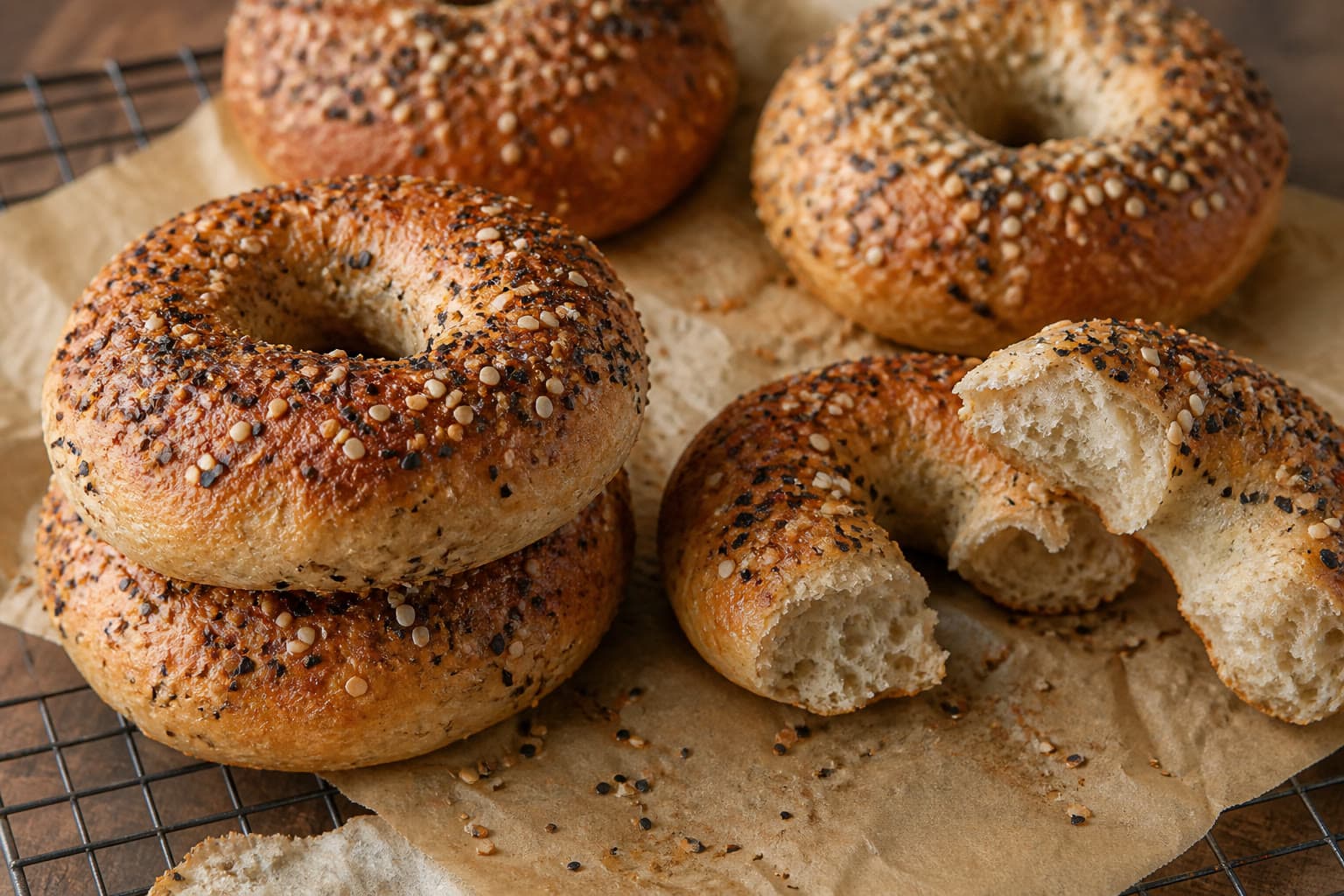
Breakfast
INTERMEDIATE
BAGELS
APR 8, 2026
Gluten-Free Sourdough Bagels
Chewy gluten-free sourdough bagels poached in baking-soda honey water, then baked hot for a glossy blistered crust.
Flatbreads
BEGINNER
FOCACCIA
MAR 1, 2026
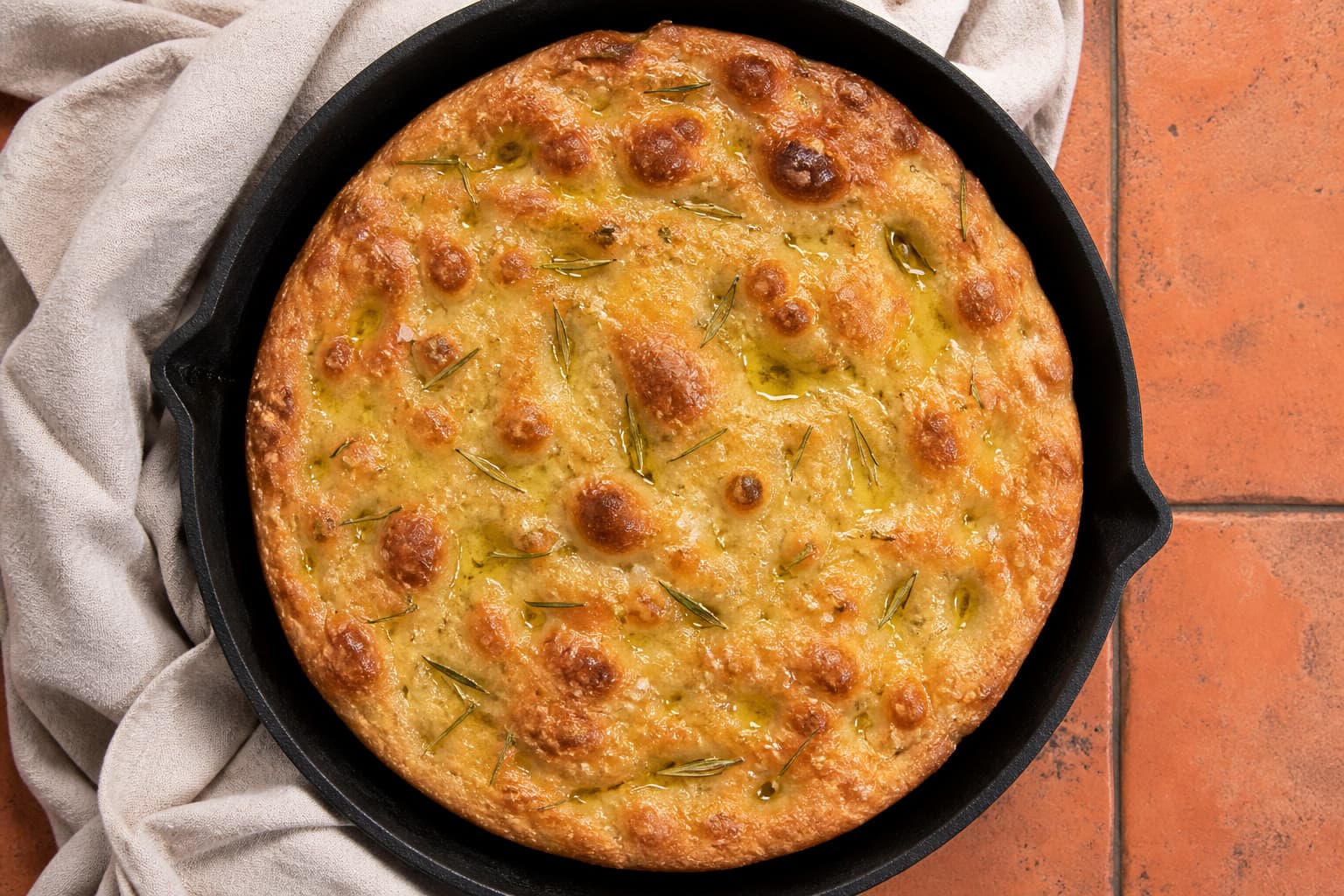
Gluten-Free Sourdough Focaccia
A pan of 105% hydration dough, dimpled in olive oil, with a crisp bottom and a plush, salty top.