Ingredients
Psyllium vs Xanthan in Gluten-Free Sourdough
Psyllium husk at 5-7% of flour weight builds an elastic gel for hearth loaves. Xanthan gum is a different hydrocolloid, useful in small doses, not a 1:1 swap.
The direct comparison
Psyllium husk and xanthan gum are both hydrocolloids, which only means they bind water and change how a dough flows. They are not interchangeable cups, teaspoons, or 'binders' in the grocery-aisle sense. Psyllium is ground seed husk from Plantago ovata. It swells into a mucilage, a long, slippery gel that can be shaped into a boule. Xanthan is a polysaccharide made by fermenting sugar with Xanthomonas campestris. It thickens and adds viscosity at much lower doses, and in bread it can read as stretchy or slimy if you treat it like psyllium.
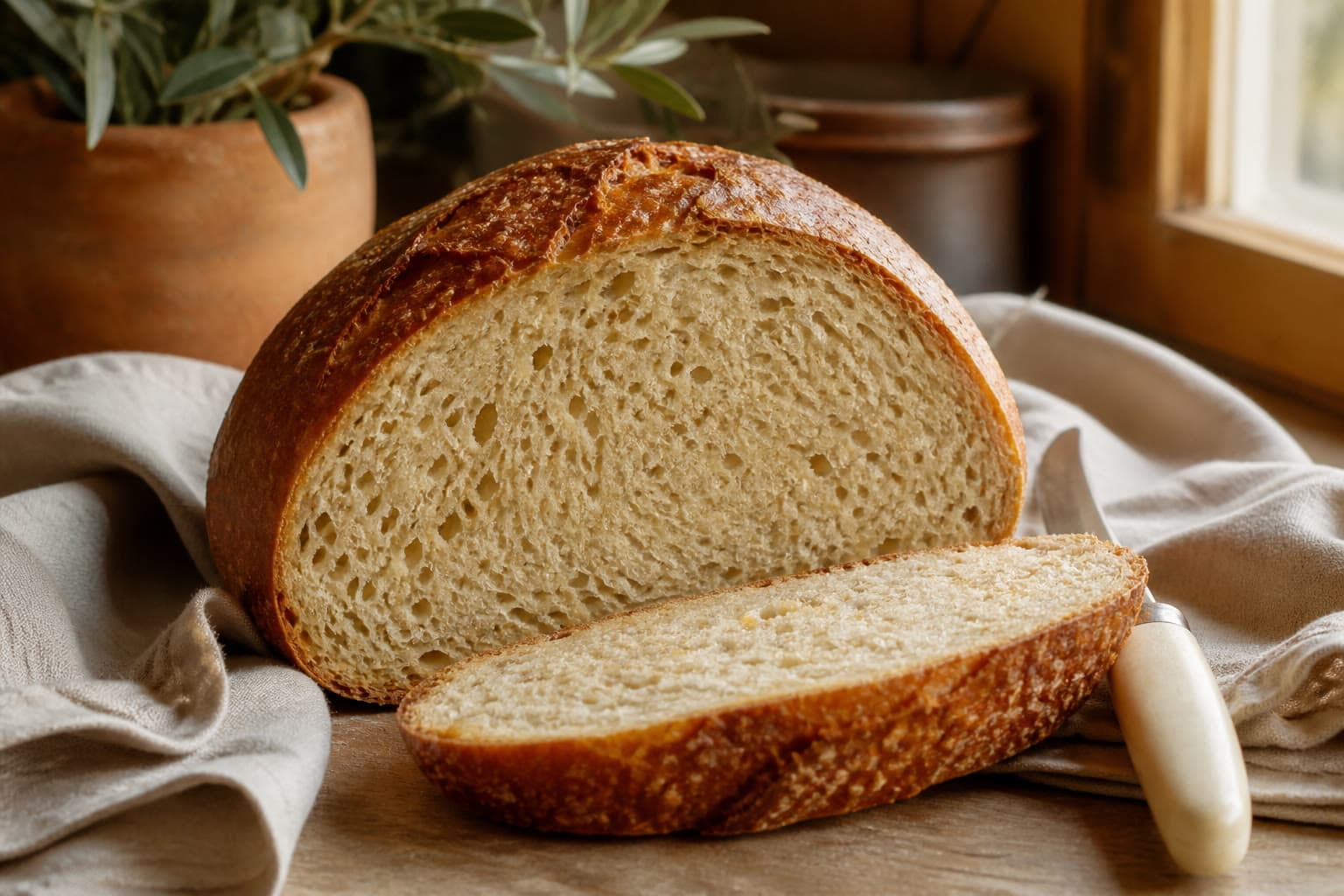
In The Kittridge Kitchen, lean gluten-free sourdough hearth loaves are psyllium breads. We use whole husk at 5-7% baker's percent of total flour weight. Xanthan, if it appears, is a supporting actor at roughly 0.3-1.0% for sandwich bread or pizza, never a 6% dump. If a commercial 1:1 blend already lists xanthan, we cut our psyllium toward the low end of the range instead of stacking gels.
What 5-7% psyllium actually looks like
Baker's percent is weight over flour weight. For 500g of gluten-free flours and starches combined, 5% is 25g whole husk and 7% is 35g. That band is where most of our boules sit. Below about 4%, a freeform loaf wants a pan. Above about 8%, the crumb starts to bounce like a wet eraser and the flavor goes grassy.
Psyllium powder is not whole husk with a marketing name. It is more finely ground, so it hydrates faster and gels harder at the same gram weight. A practical starting conversion is powder at about 80-85% of the whole-husk dose. If a formula calls for 30g husk, try 24-26g powder, rest the dough, and then decide. Volume spoons are how people accidentally make purple rubber.
- Bloom husk in part of the dough water for 5-10 minutes, or mix dry and rest 15-20 minutes. Skipping the rest leaves specks that steal water later.
- Count every gram of flour, including whole grains and starches, in the percent base.
- High-hydration focaccia can take the 6-7% end so it still stands. Pan loaves can sit at 4-5%.
How xanthan behaves in a sourdough
Xanthan is efficient. A little goes a long way, which is why gluten-free cookie mixes love it. In a wet sourdough, it increases viscosity quickly and can help a pizza dough stretch on a peel or a sandwich loaf keep a tighter shred. It does not form the same fibrous gel as psyllium, so it will not give you a Dutch-oven boule by itself unless you enjoy dense pudding.
Overdosed xanthan tastes slightly bitter and feels coated, like okra water. It also fights with a full psyllium dose. Our pizza crust is a place we will use a small xanthan assist. Our classic boule is not.
When combining them is rational
Combine on purpose, not from panic. A soft sandwich bread may use 4-5% psyllium plus 0.4-0.8% xanthan so the slice bends without tearing and the sides do not cave in the pan. A hearth loaf that already has 6% husk does not need xanthan 'for chew.' Chew, in our crumb, comes from bake temperature, cool time, and not slicing into a gel that is still liquid in the center.
If you are converting a wheat-internet recipe that calls for a tablespoon of xanthan and no psyllium, stop. Rebuild on the psyllium guide and a hydration target from hydration and crumb. Tablespoons are how gluten-free baking became a dare.
Water, because the gel drinks
Psyllium can absorb many times its weight in water. That is why a dough at 100% hydration can still look mixable after a rest, and why a dough at 80% with 7% powder can feel like concrete. Change one variable at a time. If you swap husk for powder, you usually need a splash more water or a slightly lower powder dose, not both plus an extra fold you saw on wheat video.
Xanthan also binds water, but the mouthfeel is different: slick rather than juicy. If your crumb is shiny and wet twelve hours later, you likely have too much total hydrocolloid, too much starch, an underbake, or a slice job that happened at minute forty. Read the crumb post before you throw out the flour.
Color, grind, and the purple loaf
Some lots of Indian dark psyllium gel gray-purple. Blonde Plantago ovata husk is less theatrical. The tint is pigment, not proof the bread is unsafe, but it startles guests at a potluck. If you host for celiac eaters, warn them anyway; people have a right to know what is in the slice.
Whole husk has visible flecks. Powder disappears. Neither is more 'natural' in a way that changes celiac safety. Buy a brand that is labeled gluten-free if you are baking for celiac disease, because agricultural cross-contact is a supply-chain problem, not a vibe.
Taste and aroma
Psyllium at 5-7% is usually quiet, especially blonde husk in a sorghum loaf. At high doses it adds a herbal, tea-like note. Xanthan is quieter until it is not; then it is a film. Neither should be the loudest flavor. If it is, the blend is under-fermented or the dose is a cry for help.
Whole-grain sourdough acids mask a lot. That is a feature. It is also why people over-binder a bland rice-starch loaf and then blame sourdough.
A working rule for this kitchen
Hearth boules: whole psyllium husk 5-7%, no xanthan unless a specific formula says so. Pan breads: psyllium 4-5%, optional xanthan under 1%. Pizza and flatbreads: psyllium for body, xanthan only if the dough needs peel stretch. Cookies: that is xanthan or a blend that already has it; do not psyllium a snickerdoodle into a gel.
When in doubt, mix the classic gluten-free sourdough, rest it, and ask whether the dough mounds. If it ribbons like cake batter after a full rest, you need more gel or less water, not a random second gum.
What we want you to stop doing
Stop treating 'binders' as a single pantry slot. Stop doubling both because the last loaf spread. Stop using wheat-sourdough fold timing to develop a gel that only needs hydration time. The flour blend guide will save more loaves than a third hydrocolloid.
Psyllium is the gluten analogue in our hearth work. Xanthan is a rheology tweak. Use the words that way and the formulas start to make sense.
FAQ
Frequently asked questions
How much psyllium husk should I use in gluten-free sourdough?
For most freeform loaves, 5-7% of the flour weight as whole husk. Pan loaves can sit near 4-5%. Powder is stronger; start around 80-85% of the husk weight.
Can I replace psyllium with xanthan gum?
Not at the same percentage. Xanthan is used at roughly 0.3-1.5% in bread and does not build the same shapable gel. Swapping 6% xanthan for 6% psyllium makes a gummy loaf.
Do I need both psyllium and xanthan?
Not for our classic boule. Sandwich bread or pizza sometimes uses a small xanthan dose on top of a moderate psyllium dose. Check whether your flour blend already contains xanthan.
Whole husk or psyllium powder?
Both work. Powder hydrates faster and gels harder per gram. Convert by weight; do not convert by volume. Blonde husk is less likely to tint the crumb purple.
Why is my psyllium bread gummy?
Common causes are too much hydrocolloid, slicing before a two-hour cool, underbaking below about 205F internal, or stacking psyllium on a xanthan blend without dropping the dose.
Is psyllium gluten-free and celiac-safe?
Psyllium is not a gluten grain, but buy a gluten-free-labeled product if you bake for celiac disease, and keep it away from wheat flour dust in a shared mill or kitchen.